

Part 1 was about the fact that you feel slop. You read three sentences and something at the back of your neck says “a machine wrote this”, well before you can point at what gave it away.
Feeling it is enough to despise it. It isn’t enough to train it out. If I want to teach a model to stop, I have to tell it what exactly to stop doing, and a gut feeling is not a training signal. So I started taking notes, over weeks, during the sessions where I worked on German website copy with Claude. Every time a sentence rubbed me the wrong way, I wrote down why. The notes turned into a taxonomy. Here it is.
The six classes
This isn’t complete, and I’m not claiming it is. It’s what goes wrong most often and most visibly in German marketing copy, by a wide margin. Six patterns, each with its own smell. Let’s start with the one I noticed first, because it’s the smallest.
1. Empty intensifiers
The first thing that stuck was a single word. Two, to be precise.
“wirklich funktionieren ist definitiv slop. Die sagen immer wirklich und echt.”2
“Wirklich” and “echt” mean roughly really and genuinely, and they boost a sentence that can’t carry the boost. “Das wird wirklich funktionieren” is weaker than “das funktioniert”, not stronger, because the emphasis gives away that nobody here is sure. A person who knows a thing works just says so. The machine, imitating a plausible marketing tone, puts a “wirklich” in front to be safe.
The same suspects come back in costume: “geradezu”, “regelrecht”, “durchaus”. All of them turn up the volume and add no information. Once that’s all they do, out they go. And if you look closely, turning up the volume isn’t limited to single words.
2. Puffing up
Same movement, one size larger. No longer a single word, but the reflex to make every statement sound a bit more important than it is.
“dieses wirklich, echt, so dieses Aufbauschen, das ist halt ein bisschen cringe, das ist halt auch ein bisschen Richtung AI-Slop.”3
Cringe is the right word for it. Puffing up is the tone of someone selling you a thing they don’t quite believe in. It’s exhausting to read, because every sentence tugs at your sleeve. A person lets the thing speak for itself. The model, trained on a mountain of advertising, can’t stop tugging. Sometimes the tugging stops and turns into pure mechanics, and then the tic gets so obvious you can count it.
3. The colon tic
My favourite example, because it’s mechanical enough that you can literally keep score.
“immer das mit diesen Absätzen anfangen mit Doppelpunkt, das ist klar, AI-Slop … man braucht das nicht immer so einleiten.”3
The model announces instead of saying. “Unser Ansatz:” (our approach:) and then comes the approach. “Das Ergebnis:” (the result:) and then comes the result. The colon is a drum roll in front of a statement that needs no drum roll. And the fix is stupidly simple:
“Er könnte direkt sagen, was das ist, anstatt ‚unser Ansatz:‘ kann einfach sagen ‚Meetings vom Konzept zum Ergebnis‘. Das reicht.”3
“Meetings vom Konzept zum Ergebnis”, meetings from concept to outcome. Four words, and the drum roll is gone. The announcement was packaging pretending to be contents. You spot the tic because you can delete the colon and everything before it and the sentence gets better. With the next two classes the defect is harder to grab, because here the model stops announcing and loses the thread instead.

4. Going in circles
The subtlest of the six, and the one I had the hardest time pinning down. The model reaches a spot, usually an emotional one, where something is meant to sound “meaningful”, and can’t find the exit.
“bei dem Emotionalen … fängt er an, sich zu drehen. Information inklusive sämtlicher Informationen inklusive, da hat er sich irgendwie aufgehangen.”3
“Information inklusive sämtlicher Informationen inklusive”, information including all information including, isn’t a sentence. It’s a model in a loop, missing the next real thought and filling the gap with itself. Run-ons rotating around their own axis. You read it twice and notice that the second pass added nothing. Where this class plugs the gap with repetition, the next one plugs it with off-the-rack parts.
5. Ad boilerplate
The most notorious class, and the one “anti-slop” goes after first. Prefabricated blocks that sit in every second German agency footer.
“bieten maßgeschneiderte lösungen. hochwertige materialien. … Das ist Slop, der muss raus.”2
“Maßgeschneiderte Lösungen” is tailored solutions, “hochwertige Materialien” is high-quality materials, and if your eye slid straight over both of those in English, that’s the reflex we’re talking about. The standard list I collected over time will sound familiar to anyone who has read a German service-provider site: “ganzheitlicher Ansatz” (holistic approach), “nahtlose Integration” (seamless integration), “wertvolle Einblicke” (valuable insights), “spielt eine entscheidende Rolle” (plays a decisive role), “legen größten Wert” (we place the highest value on), “mit Rat und Tat zur Seite” (at your side with advice and action), “auf Bedürfnisse zugeschnitten” (cut to fit your needs), “tauchen wir ein” (let’s dive in).
They all share one property. You can move them out of a text about tax advice and into a text about dog food without changing a word. They fit everywhere because nowhere do they say anything particular. Remember that, it’s the key to the punchline further down. One class is still missing, and it’s the only one that doesn’t appear on English slop lists at all.
6. Behördendeutsch
The last one, and a specifically German problem. English slop lists don’t know it.
“ja das ist behörden/sachlich deutsch”4
Behördendeutsch is the German of public authorities, and its engine is Nominalstil, the nominal style. German lets you convert almost any verb into a noun and then wrap that noun in a shell of prepositions: “im Rahmen der” (within the framework of), “unter Berücksichtigung” (taking into account), “die Durchführung der Maßnahme” (the carrying-out of the measure). “Wir kümmern uns”, we take care of it, becomes “die Wahrnehmung der Betreuung erfolgt”, roughly: the discharge of the provision of care is effected. Nothing has been added except gravity. The grammar is entirely normal German, which is why it slips past unnoticed, and it says the same thing with three times the words and half the life. A German language model falls into this more easily than an English one, because its training corpus is stuffed with exactly this administrative and PR register.
Six classes, then. But there’s a pattern that fits none of them and is everywhere anyway, and it’s hated enough that an entire slop metric weights it separately.
The one tic that earns its own heading
On eqbench, the “Slop” score measures how often LLMs over-use certain words, the so-called GPT-isms1. One line item in it is the not X, it's Y construction. It carries 25 % of the total weight, and an established metric handing a single pattern a quarter of its weight is why it gets a heading here rather than a line in the list above.
You know it. “Es ist nicht nur ein Tool, es ist ein Partner.” “Das ist keine Software, das ist eine Bewegung.” “Wir verkaufen nicht Meetings, wir verkaufen Klarheit.” It’s not just a tool, it’s a partner. That’s not software, that’s a movement. We don’t sell meetings, we sell clarity. In English it’s even stickier, “It's not X. It's Y.”
The pattern promises depth and delivers a rhetorical pivot. It takes a banal statement and gives it artificial significance by negating a straw man. Nobody ever claimed Raven was “just a tool”; the construction invents the opponent so it can defeat him theatrically. A sharp writer says what the thing is and trusts that to carry.
So now I had seven patterns on paper. And this is where the project nearly tipped the wrong way.
No word is ever slop
While I was building the banlist, the model got overzealous. It started banning vocabulary. Every lively word counted as suspect, everything with colour had to go. I had to hit the brakes:
“kristallklar, ruckzuck, kinderleicht, kurz gesagt, was bedeutet das konkret, kennst du das, nahtlos, souverän, absolut — kann alles drinne blieben die wörter sind doch gut”5
The words are good. That sentence is the whole series in one line.
“Kristallklar”, crystal-clear, is alive: it paints glass, transparency, nothing in between. “Ruckzuck” has a sound to it, a speed you can feel in your mouth, something like in a flash but noisier. “Kinderleicht” is concrete, easy enough that a child could do it. These aren’t shells. They’re words with contents, with an image, with tempo. People who write well use words exactly like these.
It went further. While building the German baseline, phrases showed up that I had to actively defend, because naive slop logic would have killed them: “seit Generationen” (for generations), “eine Geschichte erzählen” (to tell a story), “mittelständische Unternehmen” (mid-sized companies), “gut aussieht” (looks good), “komm vorbei” (come on by). All perfectly fine. “Seit Generationen” carries real meaning when a family workshop has been building violins since 1890. It only becomes slop when a two-year-old SaaS startup pins it to its chest.
That’s where the line runs.
Slop is text that goes through the motions of saying something without saying anything. The vocabulary was never the problem.

“Maßgeschneiderte Lösungen” is slop because it says nothing. It asserts quality without showing any, and it fits every product on earth. “Kristallklar” isn’t slop, because it shows something, a specific picture of clarity. The difference is contents against shell, never the word itself.
Which makes a fixed banlist immediately suspect. A list of forbidden words hits the shells and the good words that happen to land on it. It can’t tell “nahtlos” in “nahtlose Integration”, a shell, from “nahtlos” in a sentence where it genuinely describes the absence of a seam. That weakness, a list unable to separate contents from vocabulary, is no footnote. It becomes the central problem in Part 4. More on that later.
Slop as a fingerprint
My gut feeling has a name, GPT-isms. Described well as “the difference between text that reads like it was written by a person and text that reads like it was written by the statistical average of all persons.”6
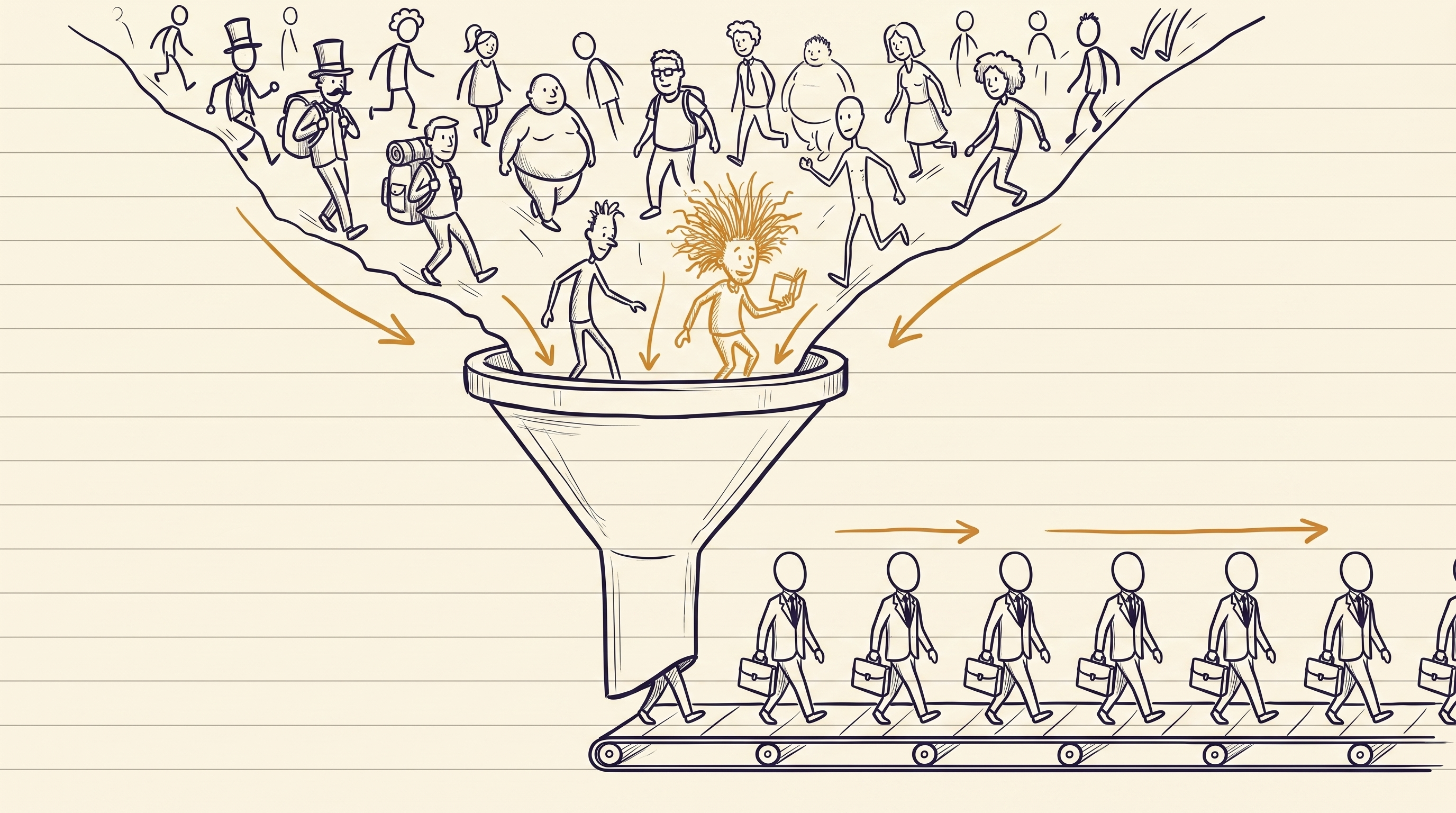
That’s precise. Slop isn’t an error in the classic sense, the grammar is usually spotless. Slop is regression to the mean. The model produces the most probable next word, and averaged across millions of sentences the most probable word is the most average one. “Maßgeschneiderte Lösungen” is the centre of gravity of German advertising language, and the model aims right there every single time.
The antislop researchers around Sam Paech have quantified it. Some of these patterns appear in LLM output “over 1,000× more frequently” than in human text7. That’s no subtle drift, it’s a linguistic fingerprint, clear enough to measure statistically. What you feel at the back of your neck is the frequency distribution bleeding through the prose.
Now I had a list
Six classes, one extra-weighted tic and a definition sharper than it looks. Slop is the empty gesture of saying, not a particular vocabulary. That finally gave me a target you can show a model, patterns with receipts instead of a feeling.
The next question was the hard one. How do you teach a model with 12 billion parameters to unlearn all of that without making it dumber? Laying a banlist over the top is easy. Training a model that keeps the good words and drops only the empty shells is a different matter entirely.
That’s Part 3.